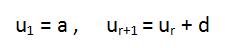
A geometric sequence, or geometric progression, is a sequence defined by u1 = a and u i+1 = rui, where r is not equal to 0 or 1.
Examples :
{2, 4, 8, 16, 32} is a geometric term with six terms.
{2, 1, 0.5, 0.25, 0.125, 0.0625, . . .} is an infinite geometric sequence.
I will skip the proving parts and jump directly to the formula gained from deriving the equations.
The sum of the geometric series a + ar + ar^2 + ... + ar^n-1, with n terms, is


S∞ is called the sum of infinity of the series.
This following examples are the typical exam-typed question. You should try it out.
Ex. Express the recurring decimal 0.296296296 ... as a fraction.
The decimal can be written as
0.296 + 0.296 x 0.001 + 0.296 x (0.001)^2 + ... and so on
which is a geometric series with a = 0.296 and r = 0.001. Since | r | < 1, the series iconvergent with limiting sum

Since 296 = 8 x 37 and 999 = 27 x 37, this fraction is in its simplest form 8/27.
Examples :
{2, 4, 8, 16, 32} is a geometric term with six terms.
{2, 1, 0.5, 0.25, 0.125, 0.0625, . . .} is an infinite geometric sequence.
I will skip the proving parts and jump directly to the formula gained from deriving the equations.
The sum of the geometric series a + ar + ar^2 + ... + ar^n-1, with n terms, is
S∞ is called the sum of infinity of the series.
This following examples are the typical exam-typed question. You should try it out.
Ex. Express the recurring decimal 0.296296296 ... as a fraction.
The decimal can be written as
0.296 + 0.296 x 0.001 + 0.296 x (0.001)^2 + ... and so on
which is a geometric series with a = 0.296 and r = 0.001. Since | r | < 1, the series iconvergent with limiting sum
Since 296 = 8 x 37 and 999 = 27 x 37, this fraction is in its simplest form 8/27.